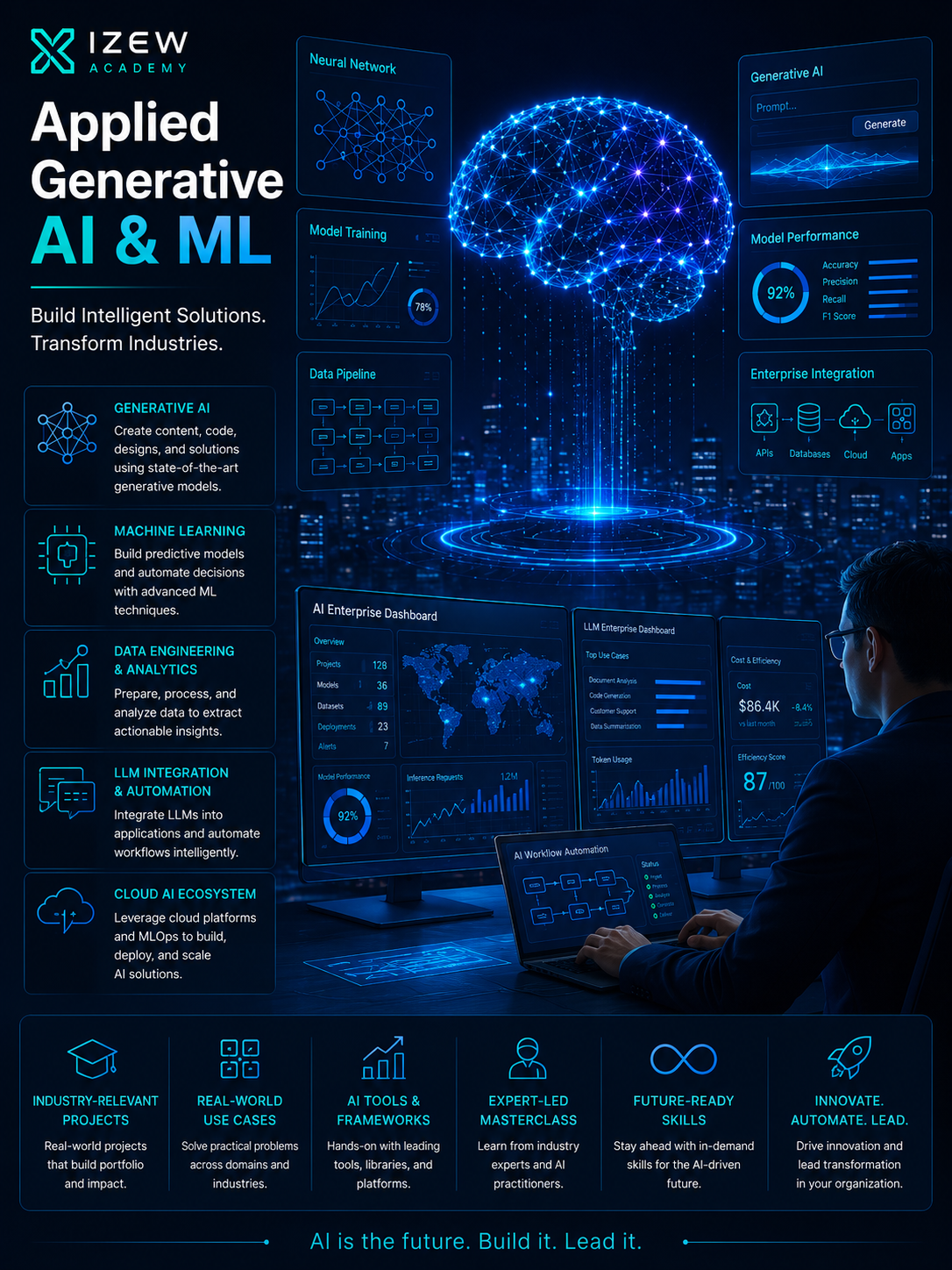
AI / ML
Applied Generative AI & Machine Learning Labs
Available
Books, masterclass volumes, and peer-reviewed research shaping the next generation of utility, power-systems, enterprise AI, and agent engineering.
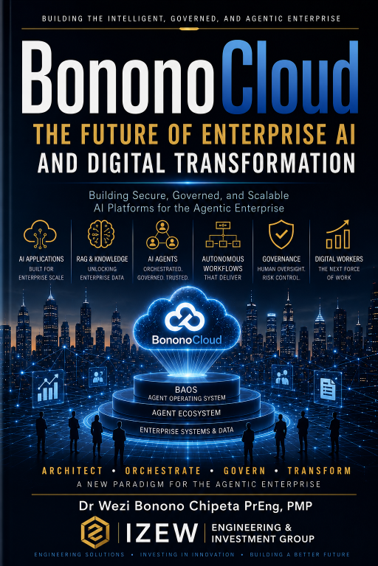
Building Secure, Governed, and Scalable AI Platforms for the Agentic Enterprise — a new paradigm covering AI applications, RAG & knowledge, AI agents, autonomous workflows, governance, and digital workers, anchored on the BAOS (Business Agent Operating System) and the Izew engineering tradition.

Chipeta, W. B. (2021). Doctoral dissertation, Westcliff University, College of Business.
This paper analyzes the extent to which Initial Coin Offerings (ICOs) create economic value to startup ventures in the digital sector using blockchain technology. The presence of principal agency problems underpinned by information asymmetry between entrepreneurs and investors could prevent the successful raising of capital and, by extension, the creation of economic value. With the presence of information asymmetry, entrepreneurs would have to use signaling as a way of showing ventures technical capabilities and transparency. The study analyzes ended and rated ICOs performed between January 1, 2018, and April 30, 2021, from various geographies. It uses hierarchical regressions between capital raised and percentage capital raised as dependent variables and various determinants of success in raising capital also regarded as creators of economic value as independent variables. The results from the study show that having a large size of project team members, providing technical information such as software code on GitHub, having longer token sale durations in the ICO public launch phase, and increasing the percentage of tokens to the public positively influence capital raised, and by extension influence creation of economic value to the startup firms.
Chipeta, W. B., & Malik, A. A. (2024). Westcliff International Journal of Applied Research, 8(1), 5–19.
doi.org/10.47670/wuwijar202481wbcaamThe rapid adoption of Generative AI has resulted in fragmented enterprise AI ecosystems characterized by isolated copilots, duplicated retrieval infrastructures, disconnected agent frameworks, and inconsistent governance mechanisms. This paper presents BononoCloud, a cloud-native multi-tenant enterprise AI platform designed to provide a unified architecture for Retrieval-Augmented Generation (RAG), AI application development, agent orchestration, and enterprise governance. BononoCloud introduces a layered architecture consisting of document ingestion services, embedding generation pipelines, vector storage systems, retrieval services, large language model integration, agent infrastructure, workflow orchestration, and governance controls. The platform is implemented using FastAPI microservices, PostgreSQL, vector databases, cloud-native deployment patterns, and multi-tenant security mechanisms. The paper contributes a reference architecture for enterprise AI platforms and presents lessons learned during the implementation of BononoCloud.
The rapid adoption of Artificial Intelligence (AI) agents is transforming enterprise software systems. While significant research has focused on individual agents, multi-agent systems, and large language model (LLM)-powered applications, limited attention has been given to the operational challenges associated with managing large-scale enterprise agent ecosystems. This paper introduces the concept of a Business Agent Operating System (BAOS), a unified operating layer designed to manage enterprise-scale agent ecosystems. BAOS provides foundational services including agent runtime management, agent registration, workflow orchestration, memory management, governance enforcement, supervision, approval workflows, and tool integration. The paper presents the BAOS reference architecture, agent lifecycle model, memory architecture, governance framework, and multi-agent collaboration mechanisms, and discusses how BAOS can serve as the operating foundation for enterprise AI platforms such as BononoCloud.
The emergence of autonomous AI agents is transforming enterprise operations by enabling software systems to perform complex tasks, make decisions, coordinate workflows, and interact with enterprise systems with increasing levels of independence. This paper introduces the Enterprise Agent Governance Framework (EAGF), a comprehensive governance architecture designed to support the safe, compliant, and accountable deployment of autonomous agents within enterprise environments. The framework proposes three governance components: the Governance Center, Supervisor Center, and Approval Queue — providing policy enforcement, behavioral monitoring, risk management, escalation handling, human-in-the-loop controls, and auditability across enterprise agent ecosystems. The paper further introduces a five-level Enterprise Agent Autonomy Model, an Accountability Chain Architecture, an Agent Risk Classification Model, and an Enterprise Audit Trail Framework.